
The complete tax guide for US travel agents
This guide pulls together the most important things you need to understand about tax as a US travel agent. It covers how your income is taxed, what you can deduct, how sales tax works, when to pay, and the mistakes that most commonly lead to an IRS problem.
HTTPS://TAX.TRAVEL/
7/4/20268 min read
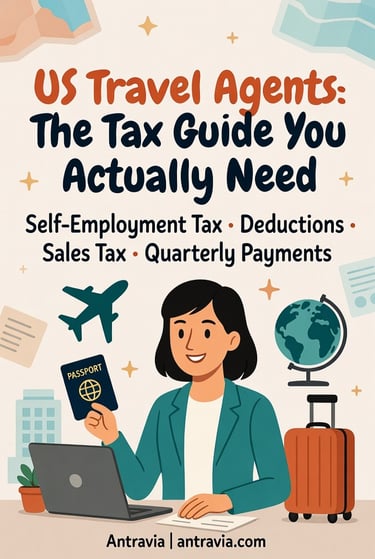
The complete tax guide for US travel agents
Published by Antravia | antravia.com
If you work as a travel agent in the United States, your tax situation is almost certainly more complicated than your friends with regular jobs. You are self-employed, which means you pay your own taxes, probably quarterly. Your income arrives at odd times, sometimes months after the booking that generated it. You may be selling travel across multiple states, each with its own rules. And if you are working through a host agency, the way your income is reported adds another layer that trips people up every single year.
This guide pulls together the most important things you need to understand about tax as a US travel agent. It covers how your income is taxed, what you can deduct, how sales tax works, when to pay, and the mistakes that most commonly lead to an IRS problem. Each section links to a longer Antravia guide if you want to go deeper on any particular area.
This is not a substitute for professional advice on your specific situation, but it will give you a much clearer picture of where you stand.
How travel agents are taxed
Most independent and hosted travel agents are considered self-employed for US tax purposes. That means you do not receive a W-2. Instead, you report your income and expenses on Schedule C, attached to your personal Form 1040, and you are taxed on your net profit, not your gross commissions or total revenue.
This is actually good news, because it means every legitimate business expense reduces your taxable income. But it also means you are responsible for something that employees never have to think about: self-employment tax.
Self-employment tax
When you are employed, your employer pays half of your Social Security and Medicare contributions. When you are self-employed, you pay both halves. The self-employment tax rate is 15.3% on net profit, covering 12.4% for Social Security and 2.9% for Medicare. For 2026, the Social Security portion applies only to the first $184,500 of net income. Above that threshold, only the 2.9% Medicare portion continues with no cap. If your net earnings exceed $400 in a year, you must file and pay this tax.
The part that surprises many agents: this is on top of your regular income tax, not instead of it. So if your net profit is $60,000, you are looking at self-employment tax plus income tax at your marginal rate. Planning for this is essential, and it starts with quarterly payments.
Quarterly estimated payments
Because no one withholds tax from your commissions or service fees, you are required to pay estimated taxes four times a year if you expect to owe $1,000 or more annually. The 2026 deadlines are April 15, June 15, September 15, and January 15, 2027. You can pay using IRS Direct Pay.
Missing these payments does not just create a lump-sum problem at year end. The IRS charges interest and penalties on underpayments, and they accumulate from the date the payment was due, not from April 15.
The timing problem
Travel agent income does not arrive in a straight line. You might close a booking in January, the client travels in June, and the commission arrives in July. This mismatch between bookings, revenue, and cash creates real complications for quarterly estimates and year-end reporting. Understanding the difference between when you earned income and when you received it matters for how you structure your accounting.
Read more: how travel agents are taxed (full guide at Antravia)
What you can actually deduct
Deductions are where travel agents either save significant money or leave it on the table. The IRS rule is straightforward in principle: expenses must be ordinary and necessary to your business. In practice, the travel industry has some specific situations worth understanding.
Standard business deductions
These are the deductions most agents know about and claim without controversy: booking software and CRM subscriptions, merchant fees and payment processing costs, marketing and advertising, professional memberships such as ASTA and CLIA, continuing education and certifications, host agency fees (though note that if your host takes a commission split, you do not claim the split as an expense, it simply never enters your gross income in the first place), business phone and internet proportional to business use, office supplies, and professional services including accounting and legal fees.
Home office
If you use part of your home exclusively and regularly for your travel business, you can deduct a proportional share of rent or mortgage interest, utilities, and insurance. The space must be used only for business, not a dual-purpose room. The IRS offers a simplified method at $5 per square foot up to 300 square feet, or you can calculate the actual proportion of your home used.
FAM trips and destination research
This is where agents often get into trouble. FAM trips can qualify as deductible business travel if they are ordinary, necessary, and directly tied to your work, for example inspecting hotels or suppliers you recommend to clients. The primary purpose of the trip must be business. If you spend three days at a trade event and then stay another week for personal travel, only the business days are deductible.
What does not qualify: a discounted personal holiday that you describe as research, or a trip where the business activity is incidental to the real purpose. Document every business trip carefully: the business purpose, who you met, what you inspected, and daily records of business activities.
The hobby loss risk
If the IRS decides your travel business is really a hobby, it can disallow your deductions retroactively across multiple years. The risk is higher if you have not turned a profit in three of the last five years, you lack a separate business bank account, you have no written business plan, and your recordkeeping is informal. An agent who books five group cruises annually, keeps proper records, and runs social media advertising is in a very different position from one who books two family holidays per year and deposits payments into a personal account.
Read more: travel advisor tax deductions (full guide at Antravia)
Sales tax: the part most agents underestimate
Many travel agents assume sales tax does not apply to them because they earn commissions rather than selling goods. This is often true, but not always, and the consequences of getting it wrong are significant. The IRS is one thing; state tax authorities running sales tax audits can assess back taxes for three to eight years, plus interest at 1% to 1.5% per month and penalties of 10% to 100% of unpaid tax.
The Wayfair decision changed everything
Before 2018, you generally only had sales tax obligations in states where you had a physical presence. The Supreme Court's South Dakota v. Wayfair ruling changed that. Now states can impose sales tax obligations based on economic nexus, meaning the volume of sales you make to customers in that state, regardless of where you or your business are located.
The most common trigger is $100,000 in revenue or 200 transactions in a year in a particular state. As of 2026, 15 states have eliminated the 200-transaction threshold and rely only on the $100,000 revenue figure. If you have clients spread across multiple states, and most travel agents do, you need to know where you are approaching these thresholds. See also USSales.tax
What is actually taxable
Commission income from travel bookings is generally not subject to sales tax. But event tickets, guided tours, merchandise, and in some states certain tourism packages can be taxable. The rules vary significantly by state. New York applies a true object test to packages: if the primary purpose of the sale is a taxable item, the entire amount may be taxable unless you separately itemize the components on the invoice. Florida treats lump-sum packages differently. California has its own framework. There is no single national rule.
Voluntary disclosure
If you have not been compliant with sales tax in states where you have nexus, the worst thing you can do is wait for an audit. Most states have voluntary disclosure programs that allow you to come forward, pay what you owe for a limited lookback period, and avoid the most severe penalties. Acting proactively is almost always cheaper than being found.
Read more: US sales tax for travel agents (full guide at Antravia)
How to file: the practical steps
Most independent travel agents file using Schedule C attached to Form 1040. If you operate as an S Corporation, you file Form 1120-S and receive a K-1 that flows into your personal return. Multi-member LLCs file a partnership return on Form 1065.
What you will need
Every source of income for the year: commissions, service fees, booking charges, overrides, bonuses, and any affiliate or advertising revenue. Host agencies typically issue Form 1099-NEC if they paid you more than $600. Collect these from every host and supplier portal you work with. Then gather your expense records, ideally from accounting software rather than bank statements alone.
Choosing your accounting method
Cash basis accounting records income when you receive it and expenses when you pay them. Accrual basis records income when it is earned and expenses when they are incurred. Most small travel agents use cash basis because it is simpler and because it better matches when money is actually available. If your business is growing, has significant deferred income, or operates across multiple currencies, accrual accounting gives a more accurate picture of performance.
Avoiding audit triggers
The IRS looks for inconsistencies between reported income and lifestyle, unusually high deductions relative to revenue, and patterns that suggest hobby activity rather than a genuine business. Travel agents specifically face scrutiny over FAM trip deductions, home office claims without clear documentation, and expenses that blend personal and business travel. Keep receipts, record the business purpose of every trip and meal, and reconcile your accounts monthly rather than reconstructing everything in March.
Read more: how to file taxes as a travel agent (full guide at Antravia)
2026 tax strategies worth knowing
A few areas that are particularly relevant for travel agents right now:
S corporation election
If you are consistently earning $60,000 or more in net profit, an S corporation election can reduce your self-employment tax burden. The structure allows you to pay yourself a reasonable salary (on which employment taxes apply) and take additional income as a distribution (on which they do not). The savings can be meaningful, but the structure adds administrative costs and complexity. This is a conversation worth having with an accountant before assuming it is right for your situation.
Retirement accounts
Self-employed individuals can contribute to a SEP-IRA, SIMPLE IRA, or solo 401(k). These contributions reduce taxable income now and build long-term wealth. A SEP-IRA allows contributions of up to 25% of net self-employment income. This is one of the most underused tax planning tools among independent travel agents.
AI tools and technology deductions
Software subscriptions, AI tools used for your business, and technology investments are generally deductible. As more agents invest in CRM platforms, AI-assisted booking tools, and content creation software, tracking these costs properly becomes more valuable.
Read more: 2026 travel agency tax strategies (full guide at Antravia)
The mistakes that actually get agents into trouble
After working with travel agents across the US and internationally, a few patterns come up repeatedly:
Not paying quarterly estimates and then facing a large bill plus penalties in April. Missing sales tax nexus in states where client volume has grown. Treating FAM trips as fully deductible without documenting the business purpose. Mixing personal and business finances, which creates problems in every direction. Failing to account for clawbacks, where a commission is reversed after a client cancels, which can distort reported income if not handled correctly. And underestimating self-employment tax, which comes as a genuine shock to agents in their first year of self-employment.
None of these are unusual or complicated problems. They are consistent patterns that good accounting and proactive tax planning resolve before they become expensive.
About Antravia
Antravia is a specialist finance and accounting consultancy for the travel and hospitality industry. We work with travel agents, tour operators, and hotel owners who want to understand their numbers, protect their margins, and run a financially stronger business. Everything we publish comes from real experience inside the travel industry, not a generic accounting textbook.
Visit us at antravia.com for the full versions of every guide referenced in this article.
Articles referenced in this guide:
Taxes for travel agents: the complete guide |
Travel advisor tax deductions |
How to file taxes as a travel agent |
US sales tax for travel agents |
Travel agency audit preparation |


References
Disclaimer:
Content published by Antravia is provided for informational purposes only and reflects research, industry analysis, and our professional perspective. It does not constitute legal, tax, or accounting advice. Regulations vary by jurisdiction, and individual circumstances differ. Readers should seek advice from a qualified professional before making decisions that could affect their business.
See also our Disclaimer page
Antravia,
Travel Finance
Where Travel Meets Smart Finance
Email:
Contact us:
Antravia Advisory
© 2025. All rights reserved. | Disclaimer | Privacy Policy | Terms of Use | Accessibility Statement
Antravia.com - Global site of the Antravia Group.
Antravia.com | Antravia.co.uk | Antravia.ae |
Finance.travel | Tax.travel | Consultancy.travel | VAT.travel | VAT.claims |
USSales.tax | EuroVAT.tax | UKVAT.tax |
contact@antravia.com
941 W Morse Blvd suite 100
Winter Park
Florida
32789